One long night. One hiding place at a time. Everyone you leave behind stays behind.
A 2.5D flip-screen stealth puzzle platformer. You play Vance, a member of The Vivid — an underclass being rounded up by the Concord regime under “Operation Clean Slate”. The ending is decided entirely by how many Vivids reach safety.
Screen-by-screen · No weapons · No second chances
No easing, no interpolation, no blending. A step covers one cell and commits. Watch the cone long enough and you know exactly when the gap opens — which is the entire game.
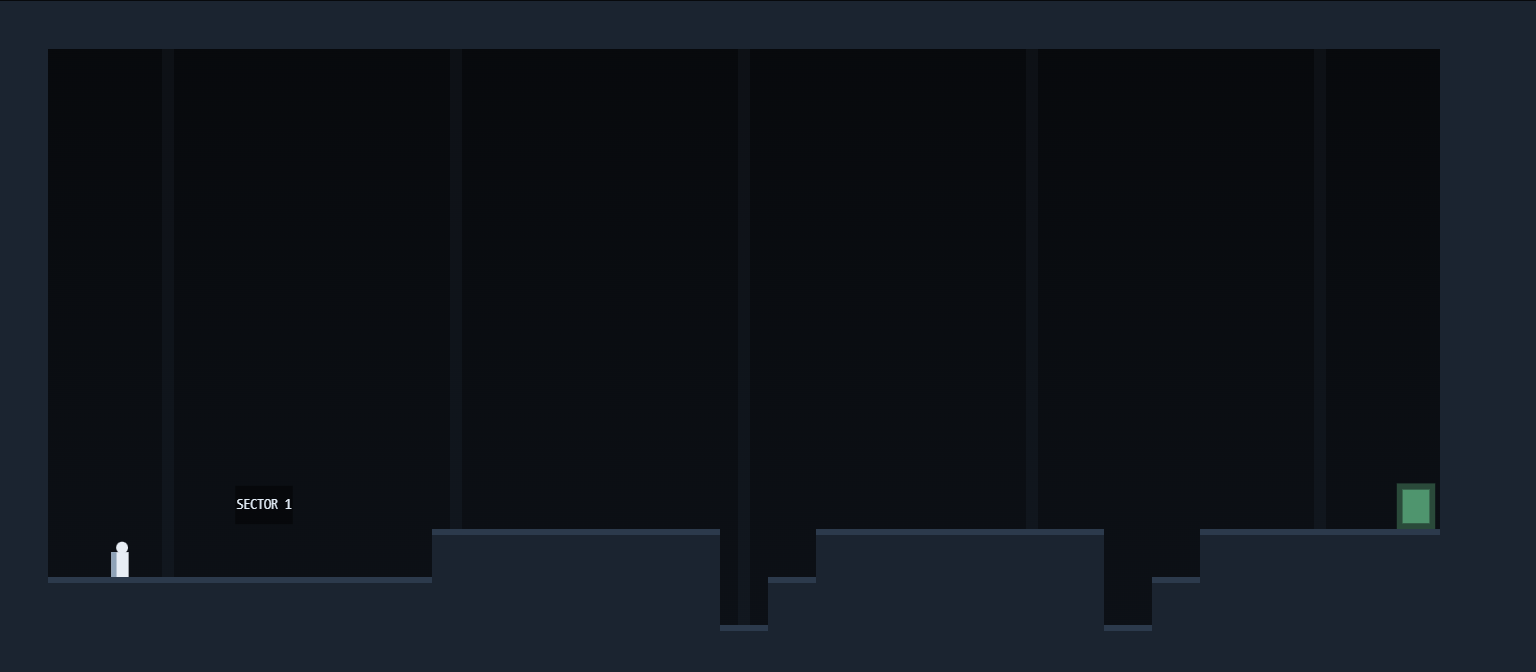
Vance is standing in shadow at the left. Shadow is not a lighting effect here. It is a place.
No weapon, no health bar, no armour. One hit is death. You never overcome a threat with force — only with observation, timing, and the regime's own infrastructure turned against it.
Later you are given one power, and it is a single button: it reaches across a room and works a machine you could never walk to. Point it at a person and nothing happens. That refusal is the game stating this constraint out loud, in the only language it uses — the world's, not a HUD's.
The camera never scrolls, pans, or blends. It cuts. Every hazard that can kill you is visible before you commit to a move. Nothing off-screen ever kills you.
Motion resolves on a grid. A step covers one cell. A running jump clears exactly the same gap every time. If you die and cannot say what you did wrong, that is our bug, not your reflexes.
No quest markers, no objective text, no tutorial pop-ups. The answer is on the screen in front of you — a flashing lamp, a hydraulic hum, a poster on a wall.
The only number tracked is how many people got out. It selects the ending.
Non-Standard personnel are reclassified from Employees to Liquidation Inventory effective immediately. Supervisors will confirm counts at shift end. Compliance is assumed.
CG-01 · Compliance checkpoint
The only number we track is how many people got out.
Saved survivors persist in the safe house — the score is a room of people
This is generated from the project's own backlog on every commit, not written by hand. When an item lands, this page changes; when one is blocked, it says so.